Big dogs pull hard, and a harness that slips, rubs or chafes makes every walk a battle. Finding the right XXL dog harness is tricky, though, because many popular brands stop at XL. Others call their largest size “XXL” without agreeing on what that means. So the only reliable approach is to measure your dog and read the girth range, not the label.
In this guide, we’ll explain how harness sizing works for large and giant breeds, how to measure correctly, and which styles work best for strong dogs.
What Size Is an XXL Dog Harness?
Most XXL dog harnesses fit a chest girth of roughly 36 to 46 inches (91 to 117 cm). For example, one heavy-duty no-pull harness sold at Walmart lists its XX-Large as 36 to 46 inches. In comparison, Ruffwear’s sizing guide tops out at XL, which covers 36 to 42 inches.
In other words, one brand’s XL can match another brand’s XXL. That’s why girth matters far more than the letter on the tag.
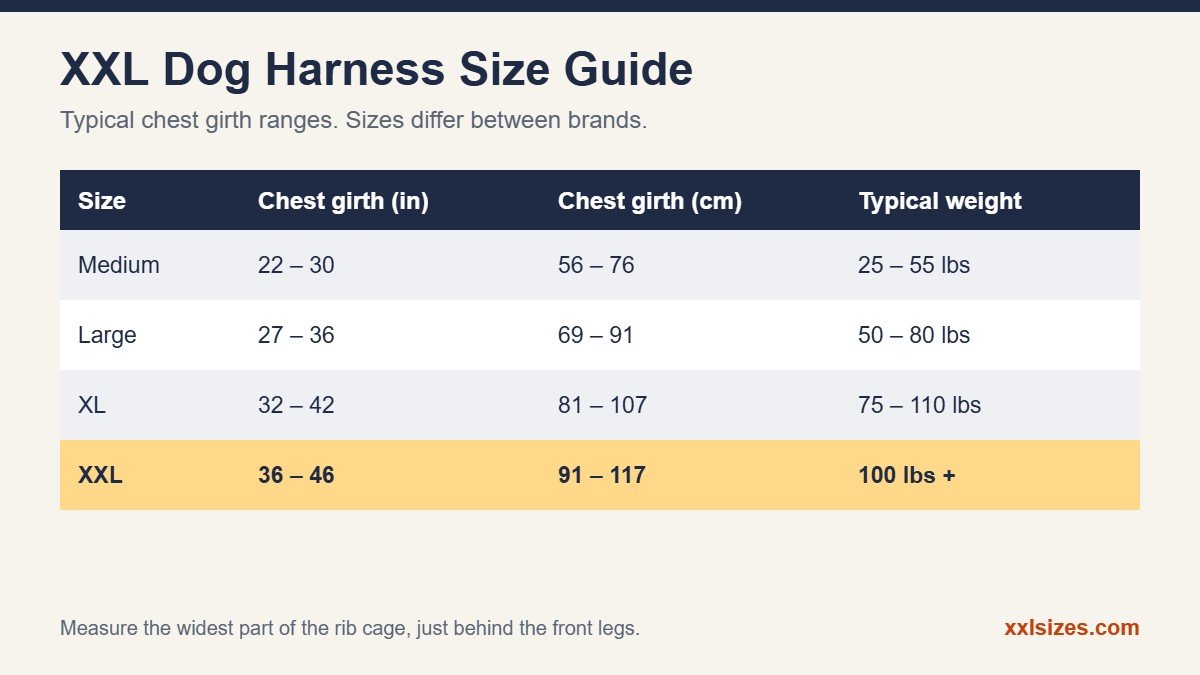
Dog Harness Size Chart by Chest Girth
| Size | Chest girth (in) | Chest girth (cm) | Typical weight |
|---|---|---|---|
| Medium | 22 – 30 | 56 – 76 | 25 – 55 lbs (11 – 25 kg) |
| Large | 27 – 36 | 69 – 91 | 50 – 80 lbs (23 – 36 kg) |
| XL | 32 – 42 | 81 – 107 | 75 – 110 lbs (34 – 50 kg) |
| XXL | 36 – 46 | 91 – 117 | 100 lbs + (45 kg +) |
These are typical ranges across brands. Still, a deep-chested Great Dane and a stocky Bulldog of the same weight can need very different sizes, so treat weight as a rough guide only.
How to Measure Your Dog for an XXL Dog Harness
- First, have your dog stand on all four legs on a flat surface.
- Next, wrap a soft tape measure around the widest part of the rib cage, just behind the front legs. This is the chest girth.
- Then measure the neck where a collar would normally sit, because many harnesses also have a neck strap.
- Finally, write down both numbers and compare them with the brand’s own chart.
If you don’t have a soft tape, use a piece of string and then measure the string against a ruler. Also, Ruffwear recommends the larger size for a growing puppy that falls between two sizes.
How Should a Harness Fit?
- Two-finger rule: you should be able to slide two fingers flat under every strap.
- No rubbing behind the legs: the strap behind the front legs should sit about a hand width back from the armpit.
- Shoulders free: a Y-shaped front leaves the shoulder joints free to move, whereas a straight bar across the chest can restrict stride.
- No twisting: the harness shouldn’t slide sideways when your dog pulls.
Check the fit again after a few walks. Straps loosen with use, and thick-coated breeds change shape between summer and winter coats.
Best Harness Styles for Large and Giant Breeds
- Front-clip (no-pull) harnesses: the leash attaches at the chest, so pulling turns the dog toward you. As a result, they work well for strong pullers.
- Dual-clip harnesses: these have both a front and a back ring, so you can switch as training improves.
- Back-clip harnesses: comfortable for calm walkers, but they give you less control over a strong dog.
- Harnesses with a handle: a top handle helps you steady a big dog, for example when lifting it into a car.
For very large dogs, look for metal hardware rather than plastic buckles, padded chest plates and reflective stitching. In addition, several adjustment points make it easier to fit an unusual body shape.
Harness vs Collar for Big Dogs
A collar puts all the pulling force on the neck. A harness, in contrast, spreads it across the chest and shoulders. Therefore, many owners of large breeds use a collar for ID tags and a harness for walks. If you’re also choosing where your dog sleeps, see our XXL dog bed size guide and our XXL dog crate size guide.
Common Questions
What size harness does a 100 lb dog need?
Usually an XL or XXL, depending on the brand. Measure the chest girth: if it’s above about 40 inches, start with XXL.
Can an XXL harness be too big?
Yes. A loose harness can slip over the head or let a leg come out of a strap. Consequently, always check the fit with the two-finger rule after adjusting.
Do giant breeds need a custom harness?
Sometimes. Breeds with very deep chests, such as Great Danes and Irish Wolfhounds, can fall outside standard ranges. In that case, look for brands that sell giant sizes or adjustable chest plates.
Choosing the Right XXL Dog Harness
To sum up, an XXL dog harness usually fits a 36 to 46 inch chest, but brands disagree on names. Measure the widest part of your dog’s rib cage, compare it with the specific brand’s chart, and then check the fit with two fingers under each strap. Get those steps right, and walks become easier for both of you.