You’re shopping for a dress shirt or a blazer, and the label just says “42”. One store calls that a Large, another lists it next to XL, and a forum thread swears it’s XXL. So what does shirt size 42 actually mean?
Short answer: in most cases, shirt size 42 is a Large (L), not XL or XXL. The longer answer depends on what the number 42 is measuring, and that’s exactly what this guide explains.
What Does Shirt Size 42 Actually Measure?
Basically, a “42” on a label measures one of two things. It’s either your chest in inches, which is common in the US and UK, or your neck in centimeters, which is common across Europe. Because both systems use numbers around 40, shoppers mix them up all the time.
US and UK Sizing: 42 as a Chest Measurement
In the US and UK, a 42 generally refers to chest size in inches. For instance, you’ll see it on suit jackets and blazers as 42R (regular), 42S (short) or 42L (long). In that system, a size 42 fits a chest of about 41 to 43 inches. On a standard letter chart, that is a Large, while XL starts around 44 and XXL around 48.
European Sizing: 42 as a Collar Measurement
On the other hand, dress shirts from German, Italian and Scandinavian brands use collar size in centimeters instead. In this case, a 42 means a 42 cm neck, which is roughly 16.5 inches. On most international charts, that is also a Large. Meanwhile, a 43 or 44 collar moves you into XL, and a 45 or 46 collar is XXL.
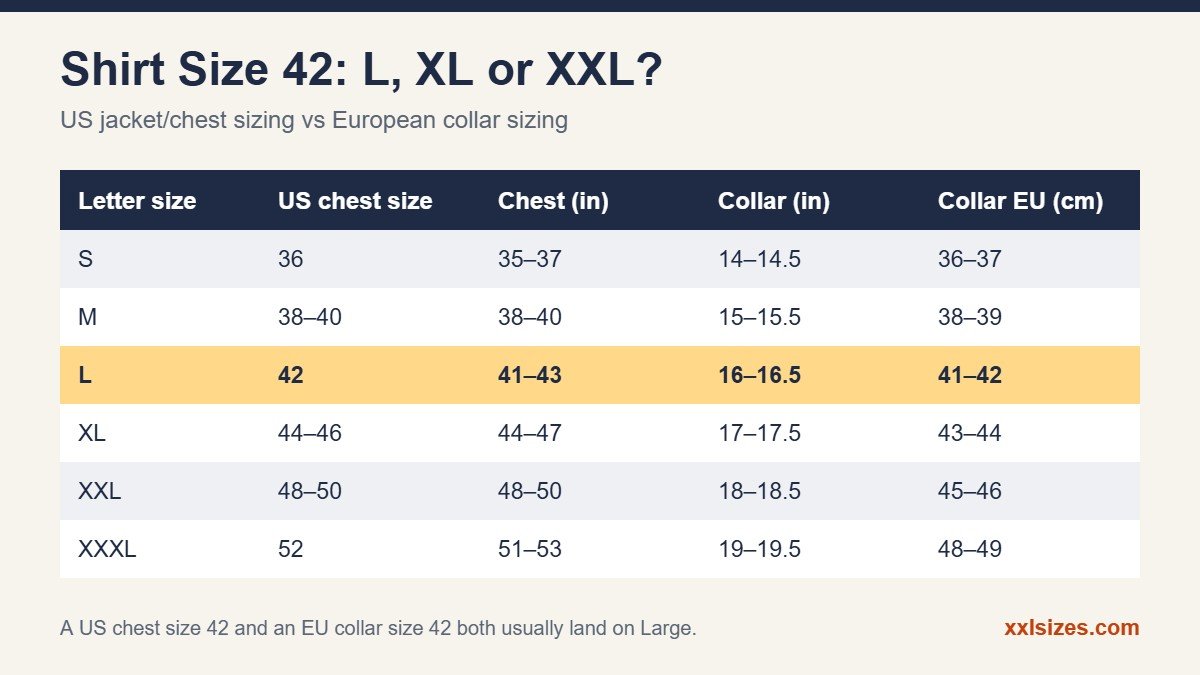
Shirt Size 42 Conversion Chart
| Letter size | US chest size | Chest (in) | Collar (in) | Collar EU (cm) |
|---|---|---|---|---|
| S | 36 | 35–37 | 14–14.5 | 36–37 |
| M | 38–40 | 38–40 | 15–15.5 | 38–39 |
| L | 42 | 41–43 | 16–16.5 | 41–42 |
| XL | 44–46 | 44–47 | 17–17.5 | 43–44 |
| XXL | 48–50 | 48–50 | 18–18.5 | 45–46 |
| XXXL | 52 | 51–53 | 19–19.5 | 48–49 |
As you can see, both kinds of shirt size 42 end up on Large. That’s a happy coincidence, and it’s why the quick answer works most of the time.
So When Is a 42 an XL or XXL?
Still, there are a few real exceptions, and they explain most of the confusion online:
- Slim-fit brands: some fashion labels cut very close to the body. Their 42 can feel like a Medium, so you may need the next size up.
- Asian sizing on Amazon or Shein: clothing made for East Asian markets often runs one or two sizes small. As a result, an Asian XXL can equal a US Large.
- Italian and French jackets: European suit sizes use a different scale, where a 42 is a very small jacket. Usually, a US 42R equals an EU 52.
- Garment vs body measurement: if a store lists the shirt’s own width rather than your body size, a “42” shirt might only fit a 40 inch chest.
In short, if a brand calls its shirt size 42 an XL, believe the brand chart over the general rule.
How to Measure Yourself at Home
- First, take a shirt that fits you well and lay it flat.
- Measure straight across the chest, one inch below the armpits.
- Then double that number to get the full chest width of the shirt.
- Finally, subtract 3 to 4 inches for a regular fit. The result is close to your body chest size.
Similarly, for collar size, measure around the base of your neck and add half an inch so you can still breathe with the top button closed. The Wikipedia guide to clothing sizes has more detail on how each country labels shirts.
Tips for Buying XXL Shirts Online
For example, if you are a true XXL, you’ll usually look for a 48 to 50 chest, or an 18 inch (45–46 cm) collar. Big retailers in the US and Europe publish separate charts for dress shirts and casual tees, so open the right one. Otherwise, you may end up comparing the wrong numbers.
On marketplaces, however, third-party sellers often copy generic charts. Therefore, check the reviews for comments like “runs small” before you order, especially for XXL and XXXL, where a wrong guess costs the most.
Related Size Guides
- Full XS to XXL size chart in inches and cm
- What XXL size means and how it compares to XL
- XXL pants sizes: waist, length and numbers
Final Answer: Is Shirt Size 42 XL or XXL?
Neither, most of the time. Shirt size 42 normally means Large, whether the 42 refers to a 42 inch chest in the US or a 42 cm collar in Europe. You move into XL at 44 and XXL at 48. Still, brand charts win every argument, so take thirty seconds to check before you click “buy”.