Clothing labels look simple until you shop from three different brands in one week. A medium from one store hugs your shoulders, while a medium from another hangs like a tent. So we put together one clean XS to XXL size chart that shows where each letter size usually starts and stops, in both inches and centimeters.
This page covers the full ladder, from XXS all the way up to XXXL. If you only care about the meaning of XXL itself, our guide on what XXL size means goes deeper on that one size.
The XS to XXL Size Chart at a Glance
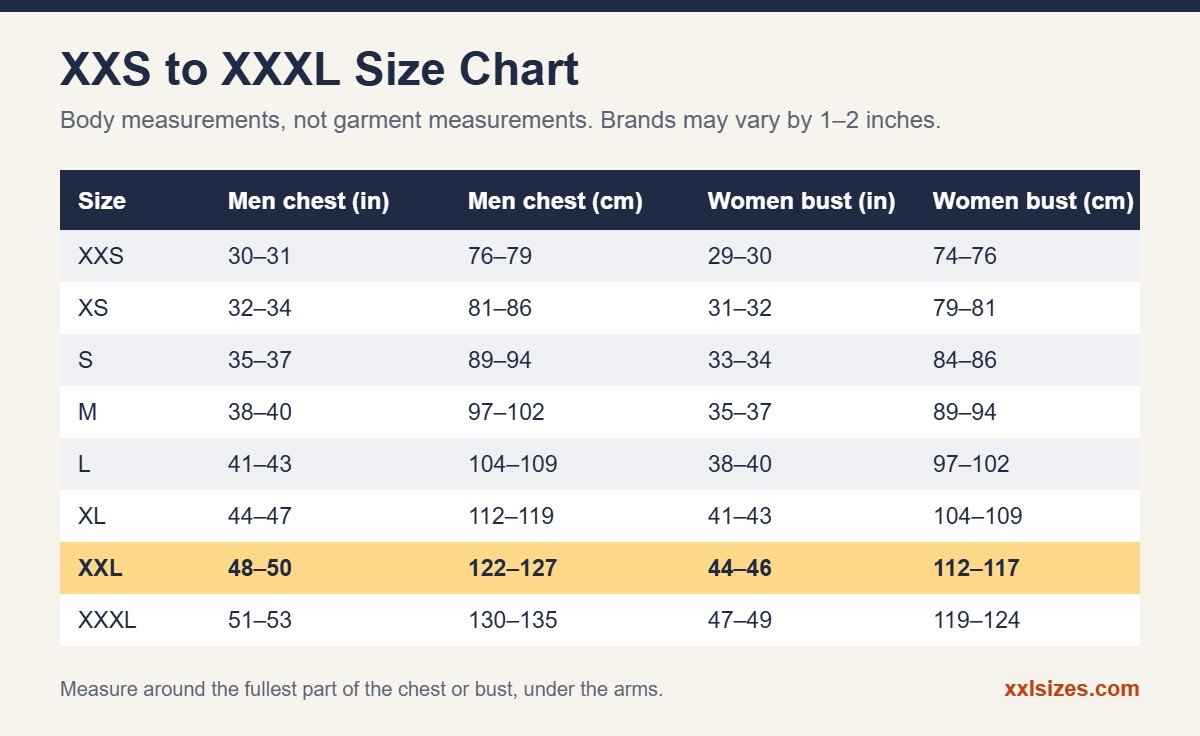
Below is the same data as the image, in a table you can copy. These are body measurements. In other words, they describe you, not the garment lying flat on a table.
| Size | Men chest (in) | Men chest (cm) | Women bust (in) | Women bust (cm) |
|---|---|---|---|---|
| XXS | 30–31 | 76–79 | 29–30 | 74–76 |
| XS | 32–34 | 81–86 | 31–32 | 79–81 |
| S | 35–37 | 89–94 | 33–34 | 84–86 |
| M | 38–40 | 97–102 | 35–37 | 89–94 |
| L | 41–43 | 104–109 | 38–40 | 97–102 |
| XL | 44–47 | 112–119 | 41–43 | 104–109 |
| XXL | 48–50 | 122–127 | 44–46 | 112–117 |
| XXXL | 51–53 | 130–135 | 47–49 | 119–124 |
Also, notice how each step on the size chart, from XS to XXL, is roughly 2 to 3 inches. That gap is the reason two neighbouring sizes can both feel “almost right”. For example, a 43 inch chest sits right on the edge of L and XL, so the cut of the shirt decides which one works.
What Each Letter Means in XXS, XS, S, M, L, XL, XXL
The letters are short forms. However, once you see them written out, the order makes sense:
- XXS – Extra Extra Small
- XS – Extra Small
- S – Small
- M – Medium
- L – Large
- XL – Extra Large
- XXL (or 2XL) – Extra Extra Large
- XXXL (or 3XL) – Triple Extra Large
Similarly, some brands write 2XL instead of XXL, and 3XL instead of XXXL. They mean exactly the same thing. Likewise, you will sometimes see “XXL XL” printed together on a tag, which usually means the item is a one-size design meant to fit both.
How to Measure Yourself for the XS to XXL Size Chart
To begin with, you only need a soft measuring tape and two minutes. If you don’t own one, a phone charger cable and a ruler work in a pinch. Here is the order we follow:
- Chest or bust: wrap the tape around the fullest part, under your arms and across the shoulder blades. Keep it level.
- Waist: measure at your natural waist, which is usually just above the belly button.
- Hips: stand with your feet together and measure around the widest part of your seat.
- Write it down: note the numbers in both inches and cm, because US stores mostly use inches while European stores use cm.
Next, breathe normally while you measure. Also, don’t pull the tape tight. A snug but relaxed tape gives the most honest number.
Why Your Size Changes From Brand to Brand
First of all, there is no single law that fixes what “Large” means. Instead, every brand builds its own pattern around a “fit model”, and then grades it up and down. As a result, the same letter can shift by an inch or two.
Of course, international groups have tried to fix this. The ISO 8559 standard, for instance, describes how body measurements should be taken and labelled. You can read a good overview on the Wikipedia page on clothing sizes. Still, very few fashion labels follow it strictly.
Besides that, a few other things can shift where you land on any XS to XXL size chart:
- Region: European and Asian brands often run one size smaller than US brands.
- Cut: slim fit, regular fit and oversized cuts use different patterns on the same label.
- Fabric: stretch cotton forgives a tight size, while linen and denim do not.
- Product type: a jacket XL leaves room for layers, so it measures bigger than a t-shirt XL.
Reading the Size Chart for Men vs Women
Generally, men’s charts lead with chest size. Women’s charts, on the other hand, lead with bust, waist and hip, because tops and dresses have to fit all three. That’s why a woman who wears M on one XS to XXL size chart may need L in a fitted kurta.
If you are shopping for women’s plus sizes, our XXL size for women guide lists US, UK and EU numbers next to each letter. For men’s formal shirts, the label is often a number like 40, 42 or 44, so check our breakdown of what shirt size 42 means.
Quick Tips Before You Order Online
- Find the brand’s own XS to XXL size chart on the product page, then compare your numbers, not your usual letter.
- Buying for a teenager? Compare youth XL vs adult small before you order.
- Read a few reviews. Buyers often say “runs small” or “size up”.
- If you fall between two sizes, size up for comfort and size down for a fitted look.
- For trousers, waist and inseam matter more than the letter. Our XXL pants size guide explains the numbers.
- Keep the tags on until you have tried the item at home.
Final Word on the XS to XXL Size Chart
After all, letter sizes are a starting point, not a promise. Use this XS to XXL size chart to find your likely range, then trust the brand’s own numbers to make the final call. Measure once, save the numbers on your phone, and online shopping gets a lot less stressful.